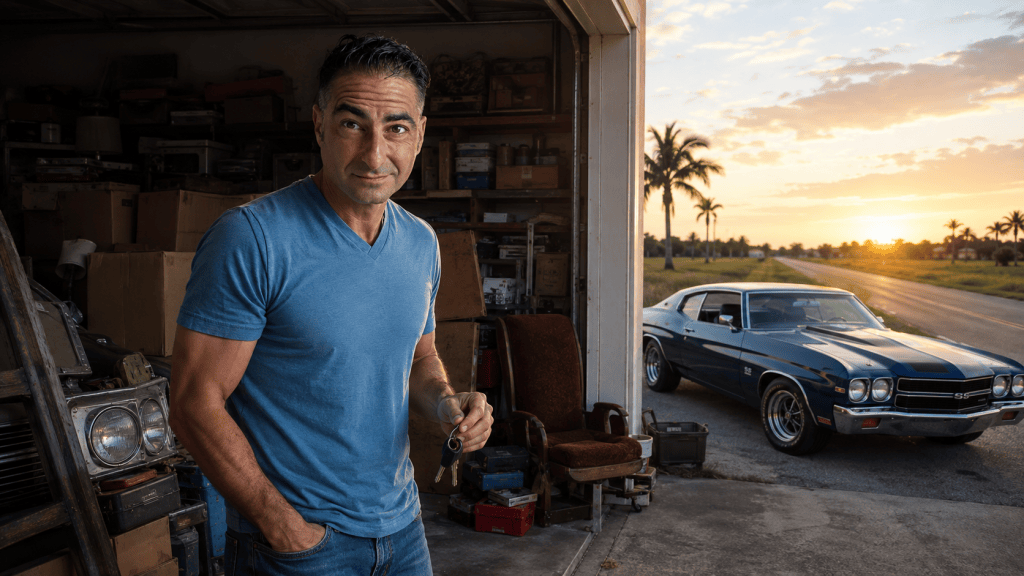
What’s something you do completely differently from how you were raised?
There is an old idea that, sooner or later, we all become our parents.
I think there is some truth to that.
You grow up watching how your parents live. You absorb their habits, reactions, values, and way of looking at the world. Even when you swear you are going to do certain things differently, pieces of them still show up in you.
That is not necessarily a bad thing.
I would not be who I am without my dad. A huge part of my independence came from watching him work for himself. He showed me that you did not have to follow the traditional path, wait for someone to give you an opportunity, or depend on a paycheck for the rest of your life.
You could create your own way.
That shaped everything about me.
I have worked for myself my entire adult life. I have taken risks, built businesses, bought and sold cars, made money, lost money, started over, and kept moving. That independent streak did not come out of nowhere. My dad gave me a foundation that I still carry today, and I am grateful for it.
But there is one thing I have learned to do differently from how I was raised: I have learned to let go of things.
My parents kept almost everything.
I do not say that as criticism. I do not even know exactly why they did it. Maybe it came from the time they grew up in. Maybe keeping things represented security. Maybe the thinking was that something could be useful again someday, so why throw it away?
Whatever the reason, I absorbed that habit too.
For a long time, I kept everything. Cars, parts, furniture, tools, paperwork, things connected to old businesses, and things connected to old chapters of my life. If something still had value—or might have value someday—it felt wrong to let it go.
But as I have gotten older, I have realized that value is not the same thing as usefulness.
Something can be worth money and still be costing you. It takes up space. It needs to be stored, moved, protected, maintained, insured, or repaired. Even if it is sitting somewhere untouched, it occupies a little bit of your mind.
Eventually, you can end up arranging your life around things you do not even use.
You need the bigger house because you have the furniture. You need the garage because you have the parts. You need the storage unit because you cannot decide what to do with everything that would not fit in the garage. Then you have another monthly payment and another place full of things you rarely see.
At some point, you have to ask yourself a simple question:
Do I own all this stuff, or does it own part of me?
I am not saying I want to own nothing. I like cars. I like tools. I appreciate things that are useful, meaningful, or built well. This is not some extreme minimalist declaration where I am going to live with one chair and two shirts.
I have simply realized that I do not need nearly as much as I once thought I did.
More importantly, I do not want my possessions to determine the size, location, or direction of my life.
I want to be able to move when an opportunity appears. I want to travel, change direction, build another business, or start a completely new chapter without dragging every previous chapter behind me.
I want the things I own to serve the life I am living now—not force me to keep living a life I have already outgrown.
The world is different now, too. We have access to almost anything we need, almost anywhere. Documents can be stored digitally. Tools can be replaced. Furniture can be bought again. Most of the things we keep “just in case” are easier to find than the space and mental energy we spend holding onto them.
There is freedom in realizing that.
Letting go does not erase where you came from. Selling something does not erase the memory attached to it. Clearing out an old room does not erase the chapter that happened there. You can appreciate what something meant without carrying it forever.
Maybe that is the real difference between becoming your parents and simply being shaped by them.
We all inherit something. Some of it is physical, but most of it is invisible: our work ethic, fears, habits, beliefs, and instincts. As adults, we get to decide what we will carry forward and what we will change.
I kept the independence. I kept the work ethic. I kept the belief that I could create my own way.
But I am learning to leave behind the idea that everything must be kept.
And the funny thing is, maybe the independence my dad gave me is exactly what allowed me to make that choice.
—Nicholas Francis


Leave a Reply