What’s a cultural tradition from your country that you love?
I never thought of car culture as a cultural tradition.
To me, it was just life.
I grew up in Michigan. Detroit was right there. Cars weren’t some hobby you discovered after you made a little money and needed something to do on the weekends.
They were everywhere.
They were part of the language.
Chevy. Ford. Mopar.
Small block. Big block.
Cam. Headers. Gears.
You learned what somebody was driving before you learned what they did for a living.
And somewhere along the way, I think we forgot just how uniquely American that is.
Detroit Didn’t Just Build Cars
Detroit built a culture.
Think about what came out of that city and the surrounding towns.
Mustangs. Camaros. Corvettes. Chevelles. GTOs. Challengers. Chargers. Road Runners. Trans Ams.
Cars that weren’t designed simply to get somebody from Point A to Point B.
They had personalities.
They made noise.
They shook at idle.
They smelled like gasoline.
And every generation had its cars.
The old guys had theirs.
My dad’s generation had theirs.
I had mine.
And kids today are finding their own version of it.
That’s the tradition.
The Garage Was a Classroom
Some of the most important education in America never happened inside a school.
It happened in a garage.
A father showing his son how to change oil.
A grandfather taking his grandson to an auction.
Somebody teaching you how to gap a spark plug.
Your buddy coming over because the damn thing won’t start.
Standing over an engine bay at midnight trying to figure out why you’ve got fuel, spark and compression and the son of a bitch still won’t run.
You learned mechanical skills.
But you learned other things too.
Patience.
Problem solving.
Responsibility.
Resourcefulness.
You learned that if something was broken, you didn’t automatically throw it away.
You figured out how to fix it.
That’s an American tradition worth protecting.
Your First Car Meant Freedom
There was another piece of it.
Freedom.
Getting your driver’s license was one of the first times in your life when the world suddenly got bigger.
You weren’t waiting for Mom.
You weren’t waiting for Dad.
You had a set of keys.
Maybe the car was a piece of shit.
It didn’t matter.
It was your piece of shit.
You washed it.
You modified it.
You put a stereo in it.
You saved money for wheels.
You drove around with absolutely nowhere to go.
And somehow those nights became some of the memories you never forgot.
That’s what automobiles represented in America for generations:
Freedom.
Then There Was Detroit Muscle
This is where America really lost its mind.
Somebody apparently decided normal transportation wasn’t enough.
We needed horsepower.
Lots of it.
Take a regular-looking car, stuff the biggest damn engine you can underneath the hood, send the power to the rear tires and see what happens.
Perfect.
Detroit muscle wasn’t subtle.
It wasn’t supposed to be.
It was loud, excessive, competitive and occasionally ridiculous.
In other words, it was incredibly American.
And decades later, we’re still obsessed with those cars.
Why?
Because they represent something bigger than horsepower.
They came from an era when America built things.
Steel came in one door.
Cars came out the other.
People went to work every morning and built something they could actually point at.
I built that.
There is pride in that.
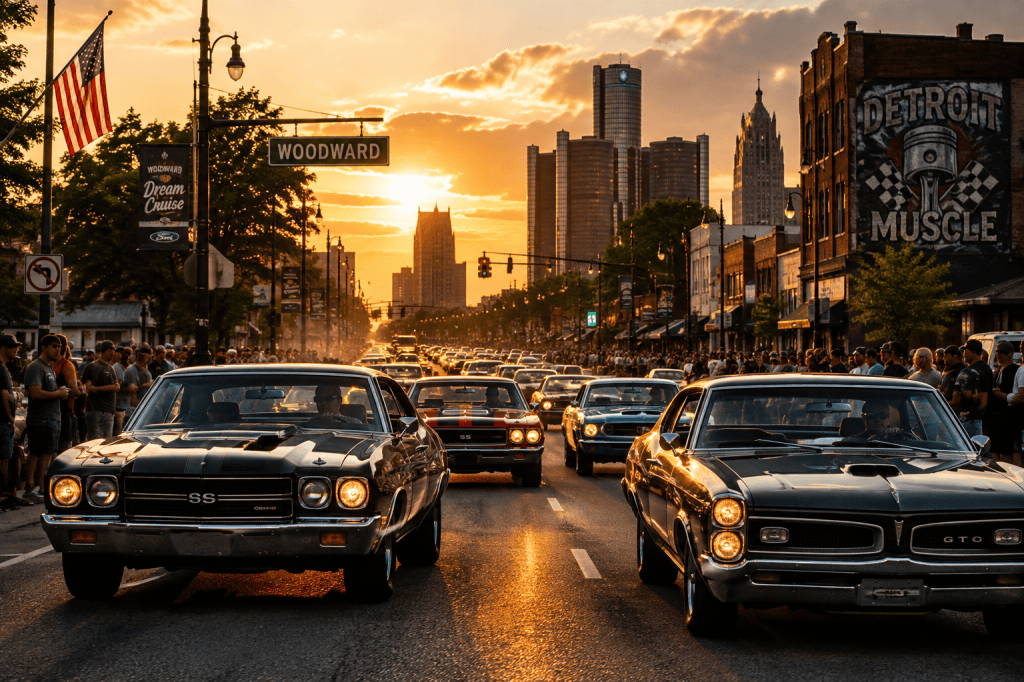
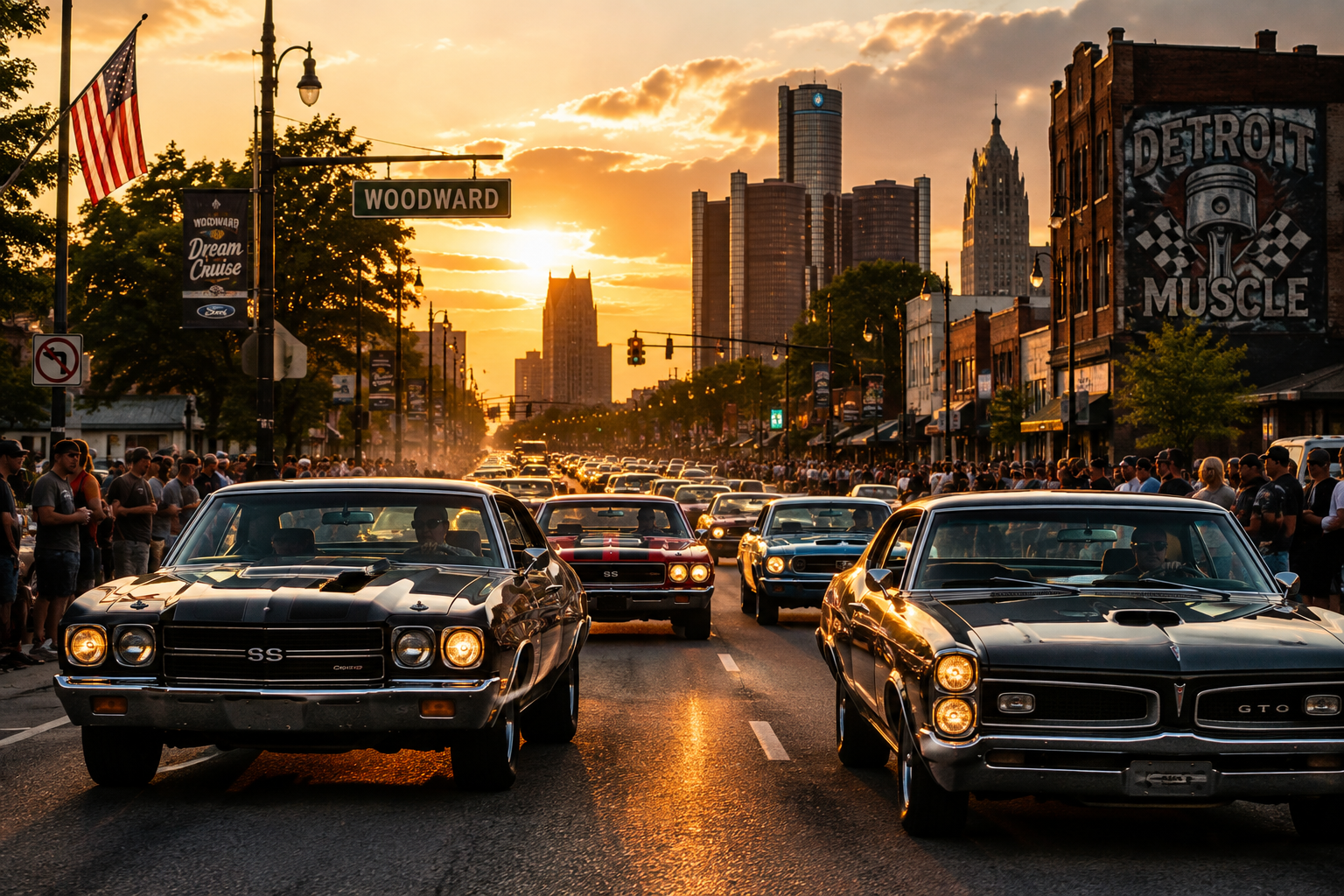
Woodward. Drag Strips. Car Shows. Cruise Nights.
Then the automobile escaped the factory and became part of the community.
Saturday night cruise.
Friday night at the drag strip.
Cars & Coffee.
Local car shows.
Guys standing in parking lots with folding chairs talking about engines for four hours.
And, of course, Woodward Avenue.
If you’ve never experienced Detroit during the Woodward Dream Cruise, it’s difficult to explain.
The entire region becomes a rolling history museum.
Cars worth hundreds of thousands of dollars sitting next to something a guy built in his garage.
Kids watching burnouts.
Old men seeing the exact car they owned when they were 19.
Three generations of a family standing around the same machine.
That’s culture.
That’s tradition.
I’ve Been Living It My Entire Life
The funny part is that I never recognized any of this as a tradition.
I just lived it.
I grew up around garages.
I went to auctions with my grandfather.
My father was a motorhead.
I became a car dealer.
I’ve bought cars, sold cars, fixed cars, broken cars and probably spent an unreasonable percentage of my life talking about cars.
And I’m still doing it.
There’s a 1970 Chevelle sitting in my garage today that can turn a perfectly productive evening into six hours of wondering why the hell an engine won’t cooperate.
And somehow I still love it.
Maybe that’s the tradition too.
Keep the Culture Alive
The automobile is changing.
Technology is changing.
America is changing.
That’s inevitable.
But I hope we never lose the culture surrounding the automobile.
Teach a kid how to change oil.
Take them to a drag strip.
Bring them to a cruise night.
Let them hear a big-block Chevy at full throttle.
Show them what somebody can build in a two-car garage with basic tools, determination and enough profanity.
Because American car culture isn’t really about cars.
It’s about freedom.
It’s about building things.
It’s about fixing things.
It’s about individuality.
It’s about fathers, sons, daughters, grandparents, friends and generations passing something down.
Detroit gave America the automobile industry.
America turned it into a culture.
And I’m damn proud to be part of it.
— Nicholas Francis
Modern Day Dealer / NFA Finance
 NFA Finance
Leave a comment