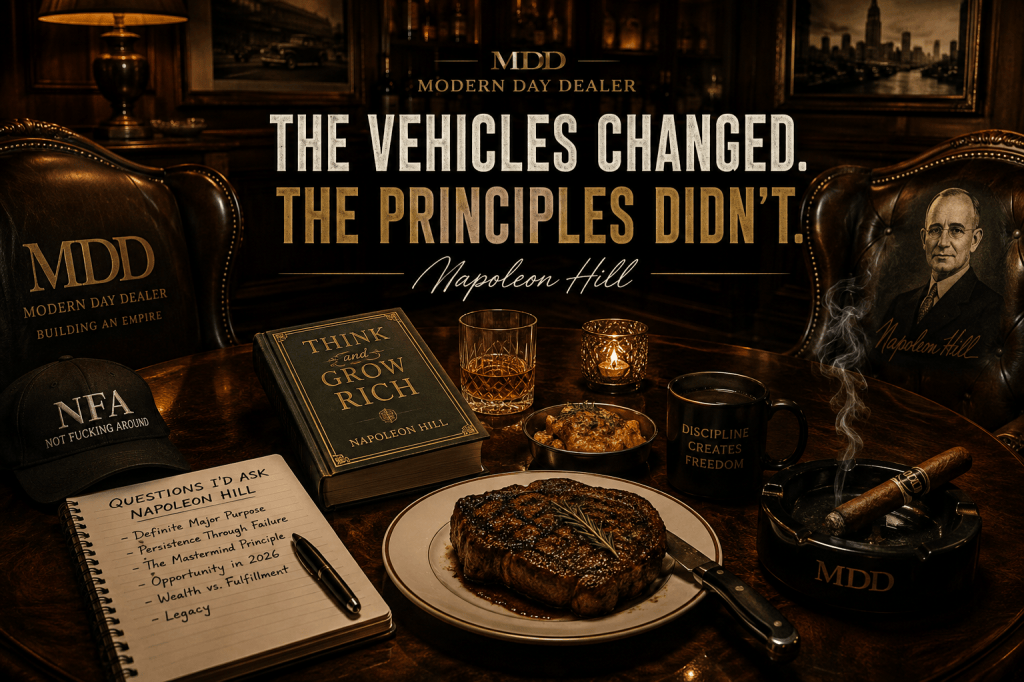
Which author would you love to have dinner with?
Today’s writing prompt asked a simple question:
Which author would you love to have dinner with?
Napoleon Hill.
No hesitation.
Think and Grow Rich is one of those books that has stuck with me because, underneath all the language from another era, the fundamental ideas are still relevant.
Definiteness of purpose.
Persistence.
Faith.
Decision.
Surrounding yourself with the right people.
Turning desire into action.
Hill wrote about these things nearly a century ago. Yet here we are in 2026, living in a completely different world, and I would argue that most of the fundamentals haven’t changed at all.
That’s exactly why I’d want to have dinner with him.
Not to ask him to sign my book.
Not to tell him how much I liked it.
I’d want to challenge him.
I’d want to know whether he believes the principles he studied in the great industrialists of his era would still create extraordinary success today.
Because the tools have certainly changed.
Henry Ford didn’t have YouTube.
Andrew Carnegie didn’t have Instagram.
Thomas Edison didn’t have TikTok.
There were no podcasts, algorithms, smartphones, personal brands or millions of people carrying a television screen around in their pocket.
Today, one person with a phone can potentially reach more people before breakfast than some of the biggest companies in the world could reach in a month 100 years ago.
Attention is the new currency.
And that’s probably where my conversation with Napoleon Hill would begin.
I’d ask him:
If you were starting from zero in 2026, what would you build?
Would he still believe the first step was developing a definite major purpose?
I think he would.
Because technology changes.
Human nature doesn’t.
People still procrastinate.
People still quit.
People still become distracted.
People still spend more time talking about what they’re going to do than actually doing it.
And the people who develop a clear objective and relentlessly work toward it still separate themselves from everybody else.
I’d also ask him about failure.
Hill spent years studying people who built enormous fortunes, but none of those people traveled in a straight line.
Neither does anybody building something today.
Businesses fail.
Deals fall apart.
Money gets tight.
People disappoint you.
Plans change.
You make the wrong decision.
You get punched in the mouth.
Then Monday morning comes and you have to get up and go again.
That’s the part of success that doesn’t photograph particularly well.
Everybody loves the finished building.
Nobody wants to watch you pour the concrete.
I’d want to know what Hill noticed about the people who kept going when there was absolutely no evidence yet that they were going to win.
Because I believe that’s where most fortunes are actually created.
Not during the victory.
During the period when quitting would have been completely understandable.
Then I’d ask him about the mastermind principle.
This one fascinates me even more today.
Hill believed strongly in surrounding yourself with people whose knowledge, experience and abilities could multiply your own.
Imagine what that concept looks like now.
Your mastermind doesn’t necessarily have to sit around the same conference table.
It can include someone across the country.
Someone across the world.
A manufacturer.
An investor.
A creator.
A programmer.
A dealer.
A business owner.
Someone you meet online who knows something you don’t.
The ability to connect people, information, capital and distribution has never been greater.
The opportunity is ridiculous.
But so is the distraction.
And maybe that’s the question I’d save for the end of dinner.
Do people today have more opportunity than the men you studied — or have we created so much noise that most people can no longer recognize opportunity when it’s sitting directly in front of them?
I have a feeling he’d say both.
We have access to tools that Ford, Carnegie and Edison couldn’t have imagined.
But tools don’t create success by themselves.
You still have to decide what you want.
You still have to work.
You still have to learn.
You still have to make decisions.
You still have to persist when things aren’t working.
And you still have to believe in something long enough to give yourself a chance to actually build it.
That’s why I’d choose Napoleon Hill.
I’d want two hours across the table from a man who spent years trying to understand how some of the most successful people of his generation thought.
I’d want to compare notes.
Their world versus ours.
Industrial empires versus digital empires.
Factories versus audiences.
Newspapers versus algorithms.
But I suspect somewhere around dessert we’d realize something.
The vehicles changed.
The principles didn’t.
And if Hill were writing Think and Grow Rich today, maybe one of the chapters would have a different title.
But the message would probably be remarkably familiar:
Figure out exactly what you want.
Build the right relationships.
Become obsessed with learning.
Take action.
Keep going.
And don’t quit just because the results haven’t shown up yet.
Because nearly 100 years later, that’s still how empires are built.
— Nicholas Francis
Modern Day Dealer
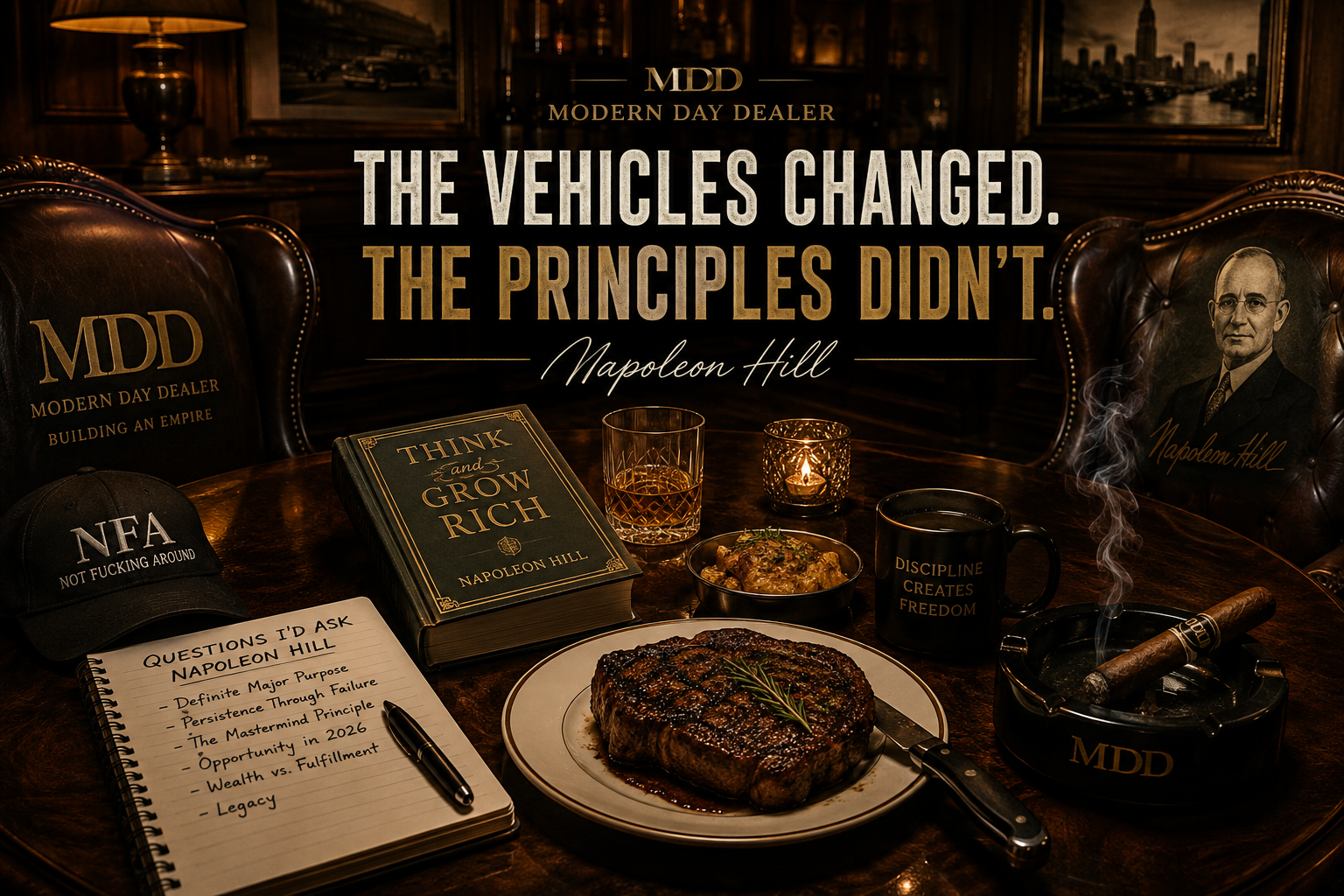
Nearly 100 years later, Napoleon Hill’s lessons on purpose, persistence, relationships, and refusing to quit still apply. The tools are different. The opportunities are bigger. But building something great still comes down to the same fundamentals.
 NFA Finance
Leave a comment