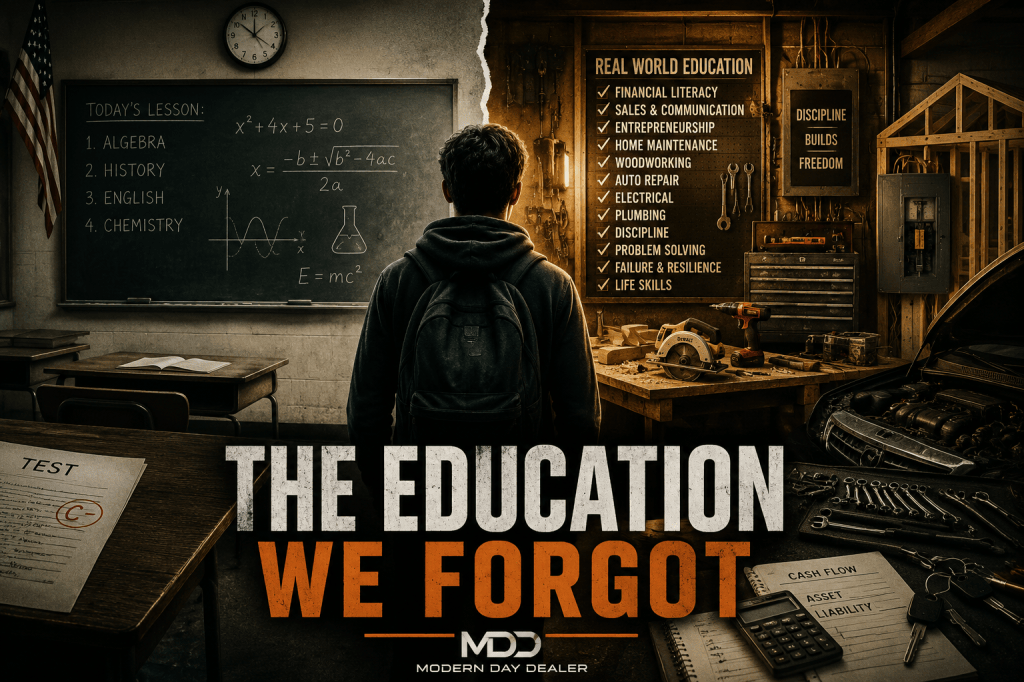
What’s a thing you wish schools actually taught?
I’ve spent more than 25 years in business.
I’ve bought cars, sold cars, lost money, made money, built things, started over, negotiated deals, dealt with customers, dealt with employees, dealt with banks, dealt with failure, dealt with success, and learned more from hard days than I ever learned from easy ones.
And the older I get, the more one thing becomes obvious:
Most of the lessons that shaped my life were never taught in a classroom.
That doesn’t mean school is useless.
Reading matters. Writing matters. Math matters. History matters. Learning how to think matters.
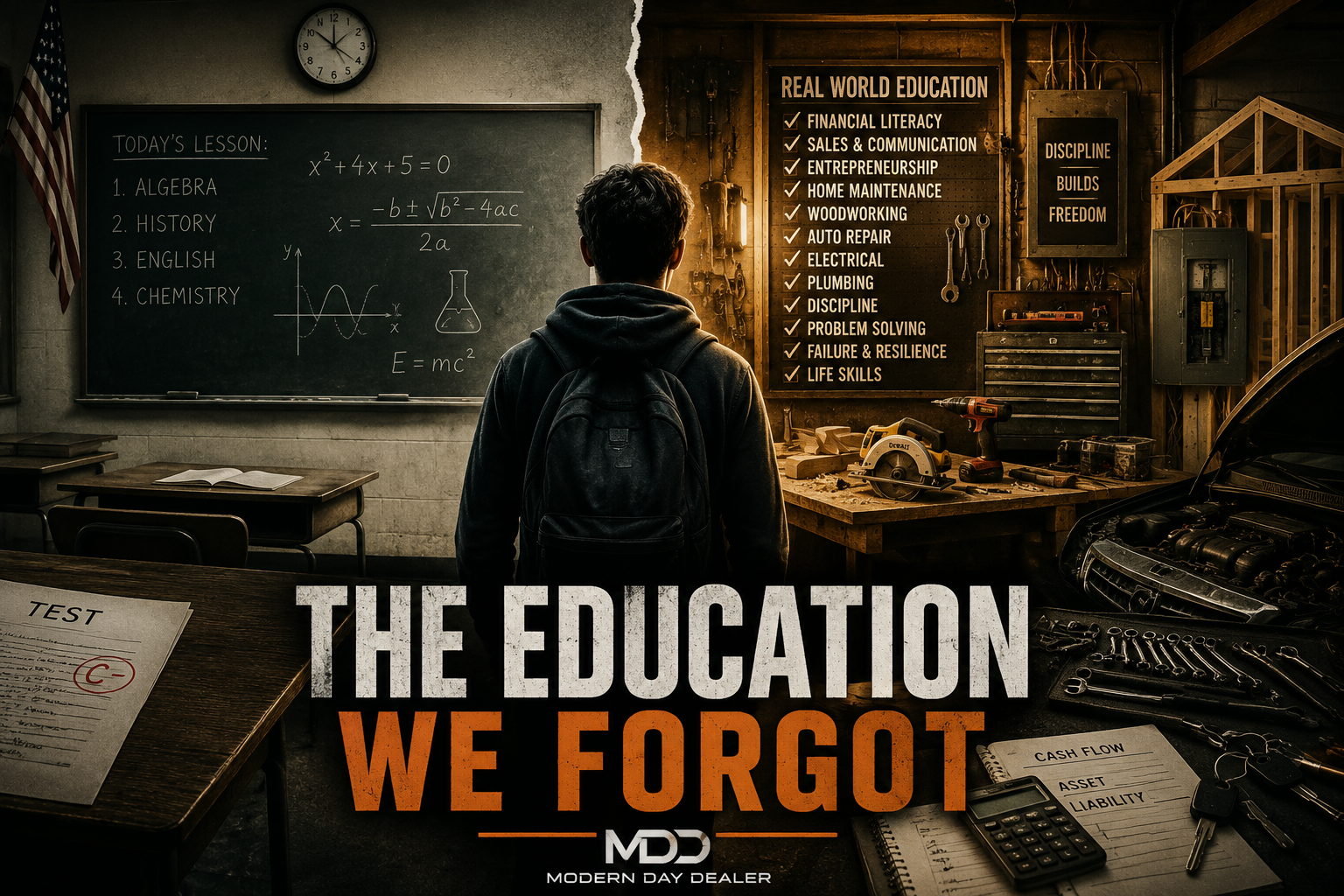
But there is a giant gap between learning how to pass a test and learning how to build a life.
That gap is where most people get their ass kicked.
WE SHOULD TEACH KIDS HOW MONEY ACTUALLY WORKS
Not just basic math.
Real money.
How credit works.
How interest works.
How debt works.
How taxes work.
How to read a loan agreement.
How a mortgage works.
How banks make money.
How compound interest can either build your future or destroy it.
The difference between an asset and a liability.
The difference between looking wealthy and actually being wealthy.
The difference between income and cash flow.
Most kids leave school knowing how to solve equations they may never use again, but they can sign an eight-year car loan at 18 without fully understanding what they just agreed to.
That’s insane to me.
Money touches almost every part of adult life.
We should probably teach people how it works before handing them access to it.
WE SHOULD TEACH SALES
People hear the word “sales” and immediately think of some guy trying to talk them into buying something.
That’s not what sales really is.
Sales is communication.
Sales is persuasion.
Sales is understanding what another person needs.
Sales is learning how to explain value.
You sell every day.
You sell yourself in a job interview.
You sell an idea to your boss.
You sell your business to a customer.
You sell a vision to an investor.
You sell yourself to the person you want to spend your life with.
If you cannot communicate value, life becomes much harder.
Knowing how to sell might be one of the highest-return skills a person can learn.
Yet most people have to stumble into it by accident.
WE SHOULD TEACH ENTREPRENEURSHIP
I’m not saying everybody should own a business.
They shouldn’t.
But everybody should understand how a business works.
Here’s a simple exercise every kid should probably experience once:
Take $20.
Figure out how to turn it into $40.
Then figure out how to turn $40 into $100.
You would learn more about business from that exercise than from memorizing a hundred definitions.
Find something somebody wants.
Solve a problem.
Price it.
Sell it.
Deliver what you promised.
Keep track of what it cost you.
Figure out whether you actually made money.
Then do it again.
That teaches initiative.
It teaches creativity.
It teaches accountability.
Most importantly, it teaches a kid something incredibly powerful:
You can create income.
You do not always have to wait for someone else to give it to you.
WE SHOULD BRING BACK SHOP CLASS
This is a big one for me.
Schools used to teach kids how to actually build and fix things.
Woodshop.
Auto shop.
Metal shop.
Basic mechanics.
Working with tools.
Building something with your own hands.
A lot of those programs have disappeared or been dramatically reduced.
I think that was a mistake.
Not everybody needs to go to college.
And working with your hands is not some lesser form of intelligence.
Knowing how to diagnose a problem, use a tool correctly, measure something, build something, repair something, and make something work again teaches you how to think.
It teaches patience.
It teaches problem-solving.
It teaches confidence.
It teaches you that when something breaks, your first response doesn’t always have to be, “Who do I call?”
Sometimes the answer can be:
“Let me figure this out.”
There is tremendous value in that mindset.
WE SHOULD TEACH PEOPLE HOW TO MAINTAIN A HOUSE
Think about how crazy this is.
Buying a home will probably be one of the largest financial decisions most people ever make.
Yet how many people leave school knowing anything about maintaining one?
Teach kids where the water shutoff is.
Teach them how a breaker panel works.
Teach them how to patch drywall.
Teach them how to unclog a drain.
Teach them how to use a drill.
Teach them how to hang a shelf correctly.
Teach them how to change an HVAC filter.
Teach them what basic preventative maintenance looks like.
Teach basic plumbing.
Basic electrical safety.
Basic carpentry.
Basic painting.
How to identify a problem before a $100 repair becomes a $10,000 repair.
You don’t have to turn everybody into a contractor.
You’re teaching self-reliance.
There is something powerful about knowing how the physical world around you works.
Cars.
Houses.
Tools.
Machines.
Construction.
We live surrounded by things that somebody had to build, maintain, and repair.
Those skills deserve respect.
And for some kids, introducing them to those skills might uncover the thing they are naturally great at.
The kid who hates sitting behind a desk might be an incredible electrician.
Or mechanic.
Or welder.
Or carpenter.
Or plumber.
Or builder.
And one day that kid might own the company employing 50 people.
That is education too.
WE SHOULD TEACH FAILURE
School usually teaches you that wrong answers are bad.
Real life doesn’t work that way.
Some of the most valuable things I’ve ever learned came from being wrong.
Bad purchases.
Bad hires.
Bad decisions.
Deals I should have walked away from.
Things I started too early.
Things I started too late.
Times I trusted the wrong person.
Times I should have listened to my gut.
Failure is tuition.
The problem is most people are taught to avoid failure so aggressively that they eventually start avoiding anything that might expose them to it.
Then they wonder why they never grow.
The person willing to fail, learn, adjust, and go again has an enormous advantage over the person trying to protect a perfect record.
Life does not reward perfection.
It rewards adaptation.
WE SHOULD TEACH DISCIPLINE
Motivation gets way too much attention.
Motivation is great when it shows up.
But motivation is unreliable.
Discipline is what changes your life.
Doing something when you don’t feel like doing it.
Doing it when nobody is watching.
Doing it when the results are still invisible.
Doing it long enough that the behavior becomes part of who you are.
The world loves dramatic transformations.
What people don’t talk about enough are the thousands of boring days that created them.
One workout doesn’t change you.
One good financial decision doesn’t make you wealthy.
One blog post doesn’t build a brand.
One sales call doesn’t build a business.
But repeat the right actions for years?
Everything changes.
I wish somebody had explained compound effort to me when I was young.
Tiny decisions become enormous outcomes when you give them enough time.
WE SHOULD TEACH COMMUNICATION
How to have a difficult conversation.
How to disagree without losing control.
How to negotiate.
How to listen.
How to apologize.
How to say no.
How to recognize manipulation.
How to ask for what you want.
How to walk away when the deal is wrong.
Those skills will affect your marriage, your friendships, your business, your employees, your customers, and probably your mental health.
Yet most people learn them through trial and error.
Usually expensive trial and error.
WE SHOULD TEACH PEOPLE HOW TO CHOOSE THEIR ENVIRONMENT
This one might be more important than almost everything else.
Who you surround yourself with matters.
The conversations you hear every day matter.
The standards around you matter.
The expectations around you matter.
Spend enough time around people who constantly make excuses and eventually excuses start sounding reasonable.
Spend enough time around people who build, create, invest, learn, work, and think bigger, and your idea of “normal” starts changing.
Environment is powerful.
Young people should understand that choosing their circle is one of the biggest decisions they will ever make.
WE SHOULD TEACH PEOPLE THAT NOBODY IS COMING TO SAVE THEM
This might sound harsh.
I actually think it’s freeing.
Nobody is required to build your life for you.
Nobody is required to make you wealthy.
Nobody is required to find your opportunity.
Nobody is required to believe in your idea.
Nobody is required to give you permission.
Once you accept that, something interesting happens.
You stop waiting.
You start moving.
You stop blaming.
You start building.
You realize the responsibility is yours.
And responsibility, while heavy, is also power.
Because if the responsibility belongs to you, then so does the ability to change things.
SCHOOL TAUGHT ME HOW TO PASS TESTS. LIFE TAUGHT ME HOW TO BUILD.
I don’t regret education.
I just wish education went further.
Teach kids algebra.
But also teach them interest.
Teach them literature.
But also teach them how to communicate.
Teach them history.
But also teach them how businesses and economies work.
Teach them science.
But also put a wrench, a hammer, a saw, and a drill in their hands and teach them how the world around them actually works.
Teach them how to get the right answer.
But also teach them what to do when they get the wrong one.
Teach them how to get a job.
But at least show them that they can create one too.
Teach them how to buy a house.
But also teach them how to take care of it once they own it.
Teach them that working with your hands is every bit as respectable as working behind a desk.
And maybe most importantly, teach them that their life will ultimately become the result of thousands of small choices nobody else will ever see.
You don’t need to have everything figured out at 18.
You don’t need the perfect plan.
You don’t need permission.
You need to learn.
You need to move.
You need to fail.
You need to adjust.
You need to stay consistent.
You need to know how to solve problems.
And you need to keep building.
Building your skills.
Building your finances.
Building your relationships.
Building your business.
Building your home.
Building your body.
Building your reputation.
Building your life.
Because after more than 25 years of doing this, that might be the biggest lesson I know:
School taught me how to pass a test.
Life taught me how to build a life.
And those are two very different educations.
— Modern Day Dealer


Leave a Reply